It’s Art Week in Cape Town, that moment in the calendar when collectors, dealers, artists, curators and the art- curious converge on the city for the Investec Cape Town Art Fair – the largest contemporary art fair on the continent and a cultural anchor that draws the international art world to the city.
This year, 126 exhibitors present the work of nearly 500 artists from 44 countries across five continents. Yet
this is not a single standalone fair, but a constellation of exhibitions, talks, gallery events and satellite programmes that ripple across the city.
Events take place in neighbourhooods, studios, historic buildings and public spaces, transforming Cape Town into a temporary, city-wide gallery. At the centre sits the 13th edition of the Investec Cape Town Art Fair, this year themed Listen.
Director Laura Vincenti describes the curatorial premise: “Through Listen, we are exploring how art becomes a space for encounter – between geographies, generations and ways of seeing. The fair is not only a meeting point for the market, but for ideas, histories, and shared futures.”
Over the past decade, the fair has evolved and now positions itself as a platform for cultural exchange and public discourse, with its influence extending beyond the Cape Town International Convention Centre through the Unbound City public programme.
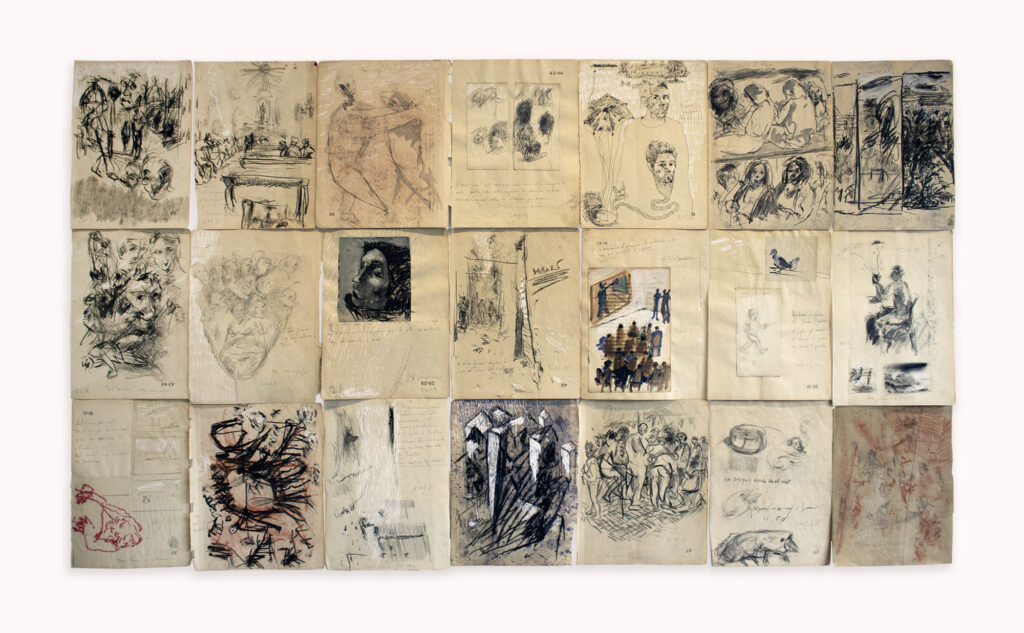
Across town, a public exhibition at BlackBrick Hotel places the work of modernist sculptor Eduardo Villa in dialogue with contemporary South African sculpture, drawing a line between past experimentation and present-day practice. At Norval Foundation, Brett Murray’s retrospective Wild Life surveys more than four decades of work, accompanied by an artist’s talk. Known for his social commentary, this retrospective of four decades includes more than 80 works with a visual language shaped as much by Disney animations and Asian vinyl toys as by West African sculpture.
At Zeitz MOCAA, a tribute to Albie Sachs traces the intertwined artistic and political histories of South Africa and Mozambique, while the Iziko South African National Gallery presents a retrospective of South Africa’s “bad boy” avant-garde artist Steven Cohen, the French-based South Africa artist whose work has long challenged conventions of identity, power and performance. The exhibition brings together installations, objects, film and archival material spanning his career.
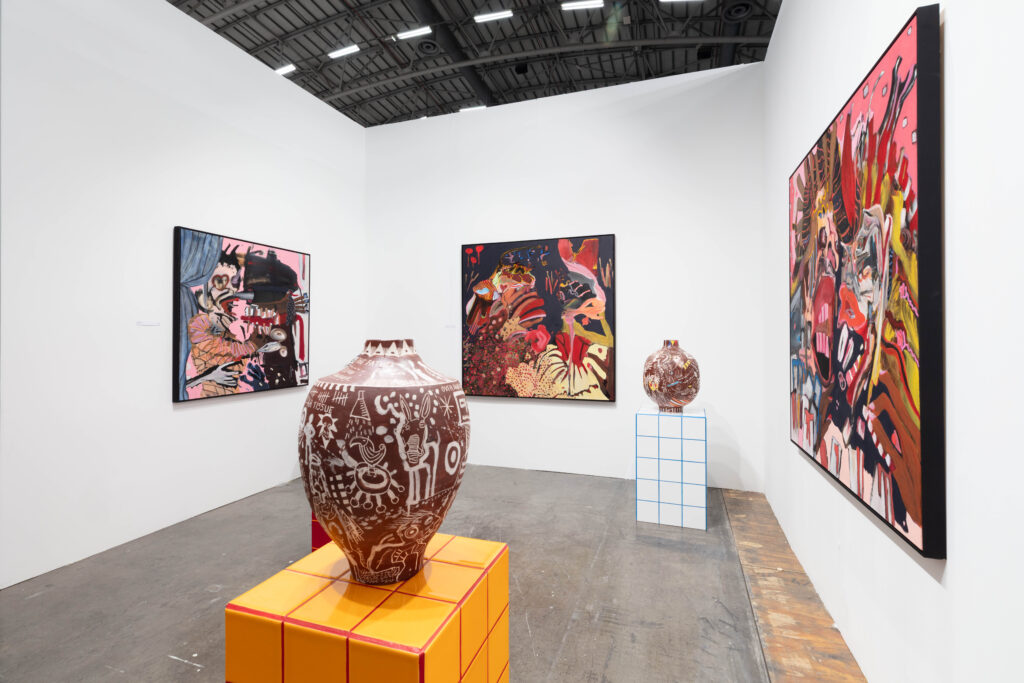
The fair ‘s international footprint continues to expand. This year it welcomes participants from cities not traditionally associated with the African art circuit – including Andorra la Vella, Douala, Lugo, Lusaka Marseille, Palermo, Santiago de Compostela, Stockholm and The Hague – reflecting growing global curiosity about contemporary art from Africa. At the same time, galleries from Barcelona, Lagos and Paris have a particularly strong presence, underscoring the role these cities play in shaping global understandings of African diaspora art.
Anchoring this global dialogue are South African galleries whose reputations have helped define contemporary art both locally and internationally, including Stevenson, Goodman Gallery, blank projects, Southern Guild and SMAC Gallery.
For one week, the city becomes less a destination than a meeting point, where varying perspectives intersect.